July 1, 2026
Gun Talk Staff
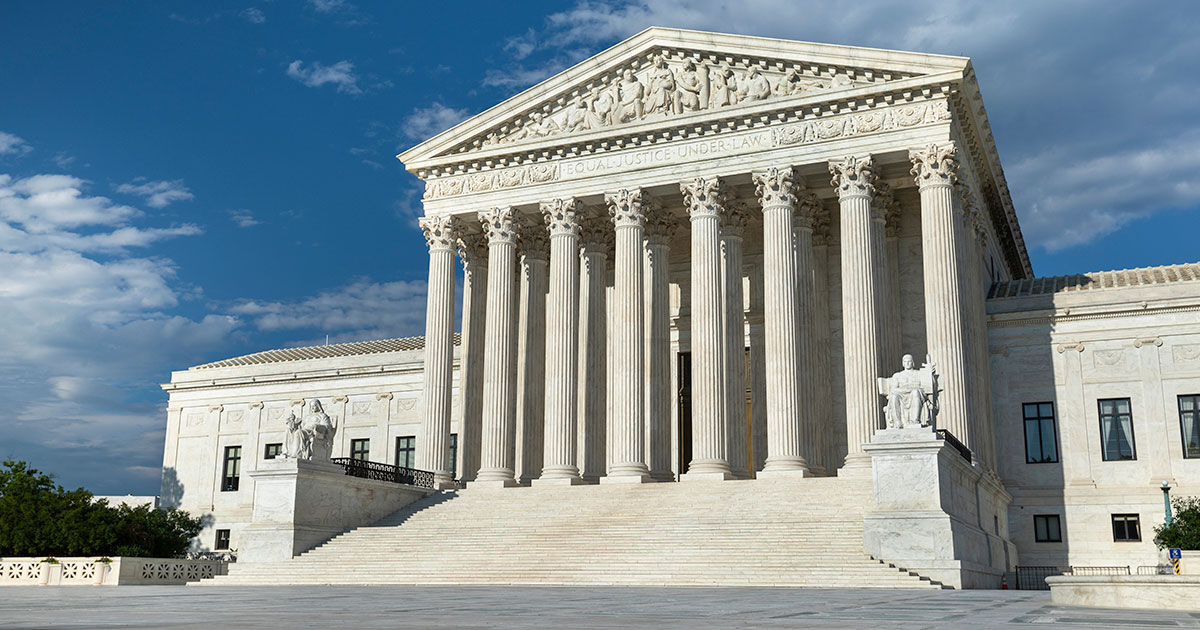
Justice Brett Kavanaugh said it in writing just a year ago: the Supreme Court “should and presumably will address the AR-15 issue soon, in the next Term or two.” On June 30, 2026 — the final day of the Court’s 2025-2026 term — his prediction came true. In a brief order released as part of the Court’s traditional end-of-term “clean-up conference,” the justices agreed to hear two consolidated cases that will finally force a definitive constitutional answer to the question that has roiled state legislatures, federal courts, and the firearms community since the Supreme Court’s landmark Heller decision in 2008: Does the Second Amendment protect the right to possess commonly owned semi-automatic rifles, including the AR-15?
The cases — Viramontes v. Cook County out of Illinois and Grant v. Higgins out of Connecticut — were consolidated and will be argued together. The central legal question, as formally presented to the Court, is: “Whether the Second and Fourteenth Amendments guarantee the right to possess AR-15 platform and similar semiautomatic rifles.” That question has a straightforward answer from the gun rights community’s perspective, grounded in Heller’s “common use” standard. What the Supreme Court says about it will determine firearms law in twelve states and every locality that has enacted an assault weapons ban — including Virginia, whose ban takes effect today.
Cutberto Viramontes, a Cook County, Illinois, resident, filed suit in August 2021 challenging Cook County’s ban on “assault weapons” — an ordinance first enacted in 2006 and revised in 2013 that bans a long list of rifle models by name, including the AR-15, along with “copies or duplicates” of banned models. The ordinance also extends to all semi-automatic rifles with a detachable magazine and any one of five specified features: a pistol grip, a protruding forward grip, a barrel shroud, a muzzle brake or compensator, or a folding, adjustable, or thumbhole stock.
Viramontes wants to purchase an AR-15-style rifle for self-defense. He cannot legally do so in Cook County. Joined by the Firearms Policy Coalition (FPC) and the Second Amendment Foundation (SAF), he argued in federal district court that the ban violates his Second Amendment right to keep and bear arms. The district court granted summary judgment to Cook County in 2024. The Seventh Circuit upheld that decision in 2025. The petition for certiorari was distributed at conference 22 times since last November before the Court finally granted review.
Grant v. Higgins challenges Connecticut’s assault weapons ban, which was enacted in the aftermath of the 2012 Sandy Hook Elementary School shooting. The Connecticut law bans commonly owned semi-automatic rifles both by name and by feature set — a broader definitional approach than many state-level bans. The case was filed by the Second Amendment Foundation and the Connecticut Citizens Defense League (CCDL) alongside three private citizens in September 2022, three months after the Supreme Court issued its landmark Bruen decision.
The Second Circuit Court of Appeals denied a preliminary injunction and upheld the ban, citing pre-Bruen circuit precedent. After a troubling and misguided preliminary injunction decision, SAF presented the case to the Supreme Court. The petition was distributed at conference 17 times since January before the Court acted. The consolidation of Grant with Viramontes signals the Court intends to issue a broad ruling addressing the fundamental constitutional question rather than a narrow decision tied to the specific features of either state’s law.
| Cases | Viramontes v. Cook County (No. 25-238) consolidated with Grant v. Higgins (No. 25-566) |
|---|---|
| Cert granted | June 30, 2026 — final day of Supreme Court’s 2025-2026 term |
| Legal question | Whether the Second and Fourteenth Amendments guarantee the right to possess AR-15 platform and similar semiautomatic rifles |
| Circuits below | Viramontes: 7th Circuit (Illinois) │ Grant: 2nd Circuit (Connecticut) |
| Oral arguments | Scheduled for October Term 2026-2027 │ Date not yet set │ One hour total allotted |
| Decision expected | Spring/early summer 2027 (based on Court’s typical timeline) |
| Petitioners | Viramontes: FPC + SAF + individual plaintiffs │ Grant: SAF + CCDL + individual plaintiffs |
| Respondents | Cook County, Illinois │ State of Connecticut |
| Supported by | NSSF, NRA, state attorneys general (anticipated), Second Amendment advocacy groups |
| At stake | Constitutional validity of assault weapons bans in 12+ states and multiple localities including Virginia |
The Supreme Court’s decision to grant certiorari in Viramontes and Grant is not a routine act of judicial housekeeping. The Court had actively avoided taking an assault weapons ban case despite repeated opportunities. Last year, it declined to hear a challenge to Maryland’s assault weapons ban, even as Justices Thomas, Alito, and Gorsuch said they would have granted that petition. Kavanaugh, while voting against granting that petition, wrote explicitly that the AR-15 question needed to be addressed soon.
The fact that the Court granted these cases — without a circuit split, which is unusual — and consolidated them for a single hour of oral argument is a strong signal of institutional intent, as Reason’s analysis of the grant noted. Courts typically grant certiorari when they want to change or clarify the law, not to affirm the existing consensus. The existing consensus, established through circuit court decisions upholding assault weapons bans, has been that such bans are constitutional. The Supreme Court’s intervention suggests that consensus is about to be re-examined — a point Washington Examiner’s coverage of the cert grant echoed, and one CNN’s reporting framed as a turning point after years of the Court declining similar petitions.
“The percolation has finally come to an end. After years of dodging the issue, the Supreme Court will finally decide the constitutionality of banning America’s favorite rifle.” — Shooting News Weekly, June 30, 2026
The constitutional argument for striking down assault weapons bans rests primarily on the standard established by the Supreme Court’s own 2008 Heller decision. Justice Antonin Scalia’s majority opinion in Heller held that the Second Amendment protects firearms “in common use at the time for lawful purposes like self-defense,” and that the government cannot ban “an entire class of arms that Americans overwhelmingly choose for the lawful purpose of self-defense.”
The National Shooting Sports Foundation estimates there are more than 32 million Modern Sporting Rifles — AR-15 platform rifles — in civilian hands in the United States. Between 1990 and 2021, Americans purchased more than 400 million rifle magazines capable of holding 30 or more rounds. By any reasonable application of Heller’s common use standard, AR-15 platform rifles are among the most commonly owned and used centerfire rifles in America. The plaintiffs’ argument is direct: these rifles are in common use for lawful purposes, therefore Heller’s own framework protects them.
The 2022 Bruen decision added another layer to the constitutional analysis by establishing that firearms regulations must be “consistent with the Nation’s historical tradition of firearm regulation” to survive Second Amendment challenge. Under Bruen, courts cannot balance government interests against individual rights — they must ask whether the challenged regulation has a historical analog in the nation’s founding-era tradition.
This framework poses significant problems for assault weapons bans. Categorical bans on classes of commonly owned civilian firearms have no plausible historical analog from the founding era. The question of whether 18th-century analogues can support a 21st-century ban on specific firearm features is precisely the kind of analysis Bruen demands — and the kind that lower courts have struggled to apply consistently to assault weapons ban cases, as AmmoLand’s analysis of the two cases lays out in detail. The Supreme Court’s consolidation of two circuits’ conflicting analytical approaches into a single case suggests the Court intends to provide that clarity.
Less than a week before the Court granted cert in the assault weapons cases, it issued its unanimous decision in United States v. Hemani, striking down the federal law that prohibited marijuana users from owning firearms. Justice Barrett, who wrote the majority opinion in Hemani along with Justice Gorsuch, is the same Justice who, as a Seventh Circuit judge in 2020, wrote a dissent arguing that the federal ban on gun possession by people with felony convictions sweeps more broadly than the historical tradition can support. Barrett’s track record on Bruen analysis — including in Hemani — does not suggest a justice inclined to uphold broad categorical gun bans that lack historical grounding. That is a meaningful data point for the assault weapons ban litigation.
A ruling in Viramontes/Grant will directly affect the constitutional validity of assault weapons bans in every state and locality that has enacted one. As of July 1, 2026, twelve states have enacted assault weapons bans at the state level: California, Connecticut, Delaware, Hawaii, Illinois, Maryland, Massachusetts, New Jersey, New York, Oregon, Rhode Island, and Washington. Virginia’s ban — SB 749, which we covered in depth last week — takes effect today, July 1. Colorado’s ban takes effect August 1.
| California | AR-15 banned │ High-capacity magazine ban │ One of the oldest state-level bans in the country |
|---|---|
| Connecticut | Center of Grant v. Higgins │ Post-Sandy Hook ban │ Both name-specific and feature-based restrictions |
| Delaware | Enacted 2022 │ Covers most semi-automatic rifles with features |
| Hawaii | Recently had separate carry restriction struck down in Wolford v. Lopez (June 25, 2026) |
| Illinois | Cook County ordinance (Viramontes) + statewide PICA (Protect Illinois Communities Act, 2023) |
| Maryland | SCOTUS declined cert in 2025 │ Fourth Circuit upheld ban │ Now in holding pattern for SCOTUS ruling |
| Massachusetts | Long-standing ban │ AG enforcement interpretation broadly restricts semi-auto rifles |
| New Jersey | ANJRPC/Cheeseman v. Platkin pending in Third Circuit │ May wait for SCOTUS ruling |
| New York | Comprehensive ban │ Part of Bruen’s home state │ Has repeatedly expanded post-Bruen |
| Oregon | Measure 114 — includes high-capacity magazine ban │ Litigation ongoing |
| Rhode Island | Among most recent state-level bans │ Enacted 2025 |
| Washington | Semi-automatic rifle ban enacted 2023 │ Feature-based restrictions |
| Virginia | SB 749 effective TODAY, July 1, 2026 │ Four active lawsuits │ DOJ action anticipated |
| Colorado | Effective August 1, 2026 │ Part of the expanding legislative wave |
The consolidation of Viramontes and Grant means the Court will hear a single hour of oral argument on the assault weapons question, with time divided between the two cases and their respective respondents. Briefing schedules have not yet been announced, but both cases have been thoroughly litigated through their respective circuits, giving the Court a comprehensive factual and legal record to work with — a record News2A’s full breakdown of the grant walks through case by case. Arguments are expected in fall 2026 — most likely between October and December — with a decision likely in spring or early summer 2027.
Virginia’s SB 749 — which took effect today despite ongoing litigation in four separate lawsuits — creates a direct and immediate connection between the state-level fight we covered last week and the Supreme Court’s newly announced case. If any of the four active Virginia lawsuits produces a preliminary injunction before the Supreme Court issues its ruling in Viramontes/Grant, that injunction could pause SB 749’s enforcement pending the constitutional resolution. Alternatively, the Supreme Court’s ruling next year could effectively moot the Virginia litigation by establishing a constitutional standard that either invalidates or validates SB 749 as a matter of federal constitutional law.
The Third Circuit heard oral arguments in October 2025 in the consolidated challenge to New Jersey’s assault weapons ban (ANJRPC/Cheeseman v. Platkin) and has not yet issued its decision. With the Supreme Court now having granted cert in Viramontes/Grant, the Third Circuit faces a choice: issue its own decision before the Supreme Court rules, or hold the New Jersey case pending the Supreme Court’s guidance. Many court watchers expect the Third Circuit to wait, effectively pausing New Jersey’s litigation in a holding pattern until the Supreme Court speaks.
The Firearms Policy Coalition, which is co-counsel in Viramontes, released a statement following the cert grant: “This is not the end of the fight to eliminate bans on so-called ‘assault weapons,’ but it marks the end of the beginning.” That framing is deliberate. Even a favorable Supreme Court ruling will require follow-on litigation to apply the new constitutional standard to the specific features of each state’s law. The ruling will establish the framework; the lower courts will then apply it to Connecticut’s features test, Maryland’s model list, California’s comprehensive ban, and every other variation.
For more than a decade, the Second Amendment community has watched federal and state courts uphold assault weapons bans under a series of legal frameworks that Second Amendment advocates — and several Supreme Court justices — have described as inconsistent with Heller and Bruen. The Supreme Court has repeatedly declined to intervene, even as the circuit courts reached conflicting conclusions and the legislative map of assault weapons bans expanded. For readers who want to track the broader history of how Second Amendment cases have moved through the Court, the Congressional Research Service’s SCOTUS tracker is a useful ongoing reference.
That deference ended June 30, 2026. The Court has taken the case. Arguments will be heard. A ruling will be issued. The constitutional question that has defined the assault weapons debate for 18 years — does the Second Amendment protect the right to own the most popular centerfire rifle in America? — will have a definitive answer from the nation’s highest court before the summer of 2027.
For Virginia gun owners living under a ban that took effect this morning: watch the courts. For gun owners in the other eleven states with active bans: the ruling will affect you directly. For gun owners everywhere: this is the moment the Second Amendment community has been waiting for since Bruen. The Supreme Court is finally going to answer the question.
“While it is never clear how the Supreme Court will decide any case, it is not likely the justices would agree to hear these cases if they simply intended to maintain the current status quo.” — AmmoLand, June 30, 2026



Gun Talk Giveaway
One lucky winner will bring home:
Open to U.S. residents 21+ only. Void where prohibited.