June 11, 2026
Gun Talk Staff
Every so often, something lands in the ammunition world that genuinely changes the conversation. Not just a new bullet weight, not just a slight velocity bump, not another cartridge that requires you to buy a new rifle to shoot it. Something that actually reframes what’s possible — and does it without asking you to spend four figures on a new platform to access the benefit.
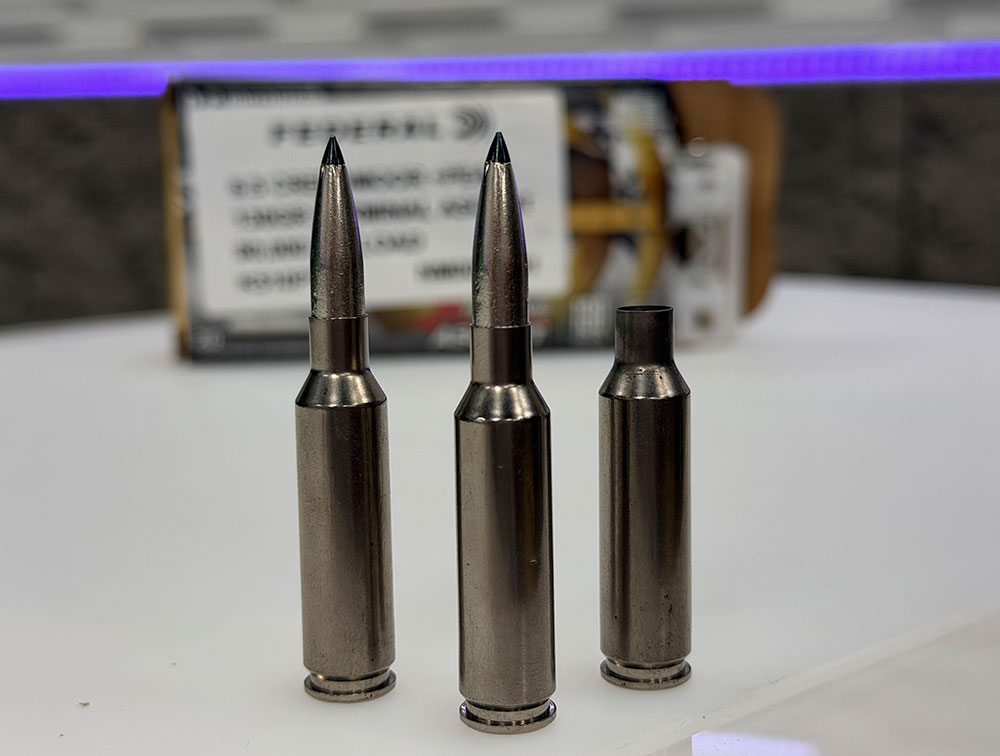
Federal’s 6.5 Creedmoor +Peak, announced June 5, 2026, is that something. Built on the same Peak Alloy case technology that Federal debuted with the 7mm Backcountry in 2024, the new +Peak loading takes the most popular rifle cartridge in the hunting and precision shooting world and gives it a performance boost so significant that the 6.5 PRC — the round that was supposed to be its more capable big brother — is now looking over its shoulder.
The lead offering in the +Peak lineup is the 130-grain Terminal Ascent load, Federal’s flagship bonded hunting bullet. That’s where this review focuses. Shipping to dealers in August 2026, this is one of the most consequential ammunition launches in recent memory, and the reasons it matters go well beyond the velocity number on the box.
To understand why 6.5 Creedmoor +Peak is a big deal, you have to understand what makes it possible — and it’s not black magic. It’s materials science.
Traditional brass cartridge cases have a pressure ceiling. That ceiling, for standard 6.5 Creedmoor, is approximately 62,000 PSI — the SAAMI maximum average pressure specification. For decades, that number was effectively a hard limit on what a given cartridge design could do. Manufacturers pushed bullet technology, powder technology, and primer technology right up to that wall, but the wall itself didn’t move.
Federal’s Peak Alloy case material — a patented, one-piece steel-based alloy construction — moves the wall. Substantially. The Peak Alloy case handles 80,000 PSI of chamber pressure safely and repeatably. That’s roughly 29% higher than the standard brass case limit. When you have nearly 30% more pressure available to work with, the laws of physics deliver a very straightforward outcome: more velocity. And with a high-BC projectile like the 130-grain Terminal Ascent, more velocity means flatter trajectory, less wind drift, more retained energy downrange, and meaningful extension of effective range.
“Peak Alloy moves the pressure ceiling from 62,000 PSI to 80,000 PSI. That’s not a minor adjustment — that’s a completely different conversation about what a cartridge can do.”
Critically, the Peak Alloy case retains the exact external dimensions of a standard 6.5 Creedmoor case. This isn’t a wildcat. It isn’t a rechambering job. Your existing 6.5 Creedmoor rifle — bolt action, gas gun, lever gun — chambers and fires 6.5 Creedmoor +Peak ammunition. Federal recommends checking with your specific firearm manufacturer for compatibility guidance, and a few break-action designs are excluded, but the vast majority of 6.5 Creedmoor owners can run this ammunition in the rifle they already own. The rifle didn’t change. The ammunition changed everything.
The Terminal Ascent projectile is already one of the most well-regarded hunting bullets in Federal’s lineup — a bonded, polymer-tipped design engineered for controlled expansion across a wide velocity window. This matters more than it might seem. Many premium hunting bullets are optimized for a specific velocity range, and running them significantly faster than designed can produce over-expansion, fragmentation, or both. Federal’s Terminal Ascent was engineered with flexible bonding technology that performs from close-range impact velocities all the way down to long-range impact velocities that would cause lesser bullets to fail to expand.
Launching the 130-grain Terminal Ascent at velocities consistently exceeding 3,050 fps — and in some test configurations clearing 3,100 fps through 24-inch barrels — the +Peak loading doesn’t break the bullet. The Terminal Ascent handles the increased velocity with the same controlled expansion and deep penetration that made it a hunting standout at standard Creedmoor velocities. You’re getting more speed without sacrificing the terminal performance characteristics that hunters actually depend on to make clean kills.
At distance, the velocity advantage compounds. A 130-grain bullet at 3,100 fps retains velocity, energy, and trajectory advantage over the same bullet at 2,800 fps in ways that become increasingly meaningful as range extends. At 500 yards, the difference is significant. At 800 yards, it’s the difference between a marginal hit and a confident one.
| Bullet | 130-grain Federal Terminal Ascent (bonded, polymer-tipped) |
|---|---|
| Case | Peak Alloy — patented one-piece steel-based alloy construction |
| Pressure | 80,000 PSI (vs. 62,000 PSI for standard 6.5 Creedmoor brass) |
| Muzzle Velocity | 3,050–3,100+ fps (24" barrel) │ 250–300 fps gain over standard brass load |
| vs. 6.5 PRC | Meets or exceeds 6.5 PRC velocity — 50–100 fps faster from equivalent barrel |
| Muzzle Energy | ~20% increase over standard 6.5 Creedmoor equivalent load |
| Recoil | Comparable perceived recoil to standard 6.5 Creedmoor load |
| MSRP | $59.99–$78.99 / 20 rounds (in line with standard 6.5 Creedmoor and 6.5 PRC pricing) |
| Availability | Shipping to dealers August 2026 │ Online availability to follow |
| Compatibility | Any compatible 6.5 Creedmoor rifle — consult manufacturer; most bolt guns, gas guns, lever guns compatible |
| Suppressor | Fully compatible — suppressed and unsuppressed performance equal |
The ballistic conversation around 6.5 Creedmoor +Peak is really a three-way comparison: standard 6.5 Creedmoor brass, 6.5 Creedmoor +Peak, and 6.5 PRC. Here’s where things get genuinely interesting — and genuinely uncomfortable for 6.5 PRC owners.
| Category | 6.5 Creedmoor (Standard) | 6.5 Creedmoor +Peak | 6.5 PRC |
|---|---|---|---|
| Bullet Weight | 130 gr | 130 gr | 130 gr |
| SAAMI Pressure | ~62,000 PSI | 80,000 PSI | ~65,000 PSI |
| Muzzle Velocity | ~2,800 fps | 3,050–3,100 fps | ~2,970–3,000 fps |
| Velocity Gain | Baseline | +250–300 fps | +150–200 fps over standard Creed |
| Action Required | Short action | Short action | Short action (larger case) |
| Bolt Face | Standard .308 | Standard .308 | Larger / magnum |
| Recoil | Mild | Comparable to std Creed | Moderate — more than Creed |
| Price (approx.) | ~$40–$55/20rd | ~$60–$79/20rd | ~$55–$75/20rd |
| New Rifle Needed | N/A | No | Yes — different chamber |
| Short Barrel Perf. | Limited | Excellent — 16" outperforms std 24" | Better than std Creed, less than +Peak |
The table tells the story. The 6.5 Creedmoor +Peak loads to a higher pressure than the 6.5 PRC, uses a smaller, lighter case, runs off the same standard bolt face and short action that the base Creedmoor uses, and delivers velocity that meets or beats the PRC — all without requiring a new rifle, without meaningfully increasing felt recoil, and at a comparable price point.
“The +Peak load from a 16-inch barrel outperforms the standard 6.5 Creedmoor from a 24-inch barrel. That is a sentence that should make every suppressed short-barrel hunter sit up straight.”
That short-barrel data point deserves special emphasis. In testing reported by multiple publications, the +Peak loading through a 16-inch barrel produced velocity that exceeded what standard 6.5 Creedmoor loads deliver from a 24-inch barrel. In an era where suppressed hunting rifles are increasingly the norm — shorter, lighter, and quieter — that’s not a marginal improvement. That’s a fundamental redefinition of what a short-barrel precision hunting setup can do. We tested it out of an 18-inch Sig Cross and pushed 3,040 fps – OUT OF AN 18-INCH BARREL! That is incredible when the velocity of a 140 gr. Hornady ELD-M was sitting around 2,480 fps. Not apples to apples, but significant enough to make us want more.
The most direct hunting benefit of the +Peak loading is straightforward: the additional velocity extends the range at which the 130-grain Terminal Ascent arrives at target with sufficient energy and velocity for reliable expansion and lethal performance. Terminal Ascent is designed to expand at low impact velocities — a design feature that’s always made it a strong choice for longer shots — but more impact velocity is always a good thing on game, and the +Peak loading provides it.
For western hunters who might face shots at 400–600 yards on elk, mule deer, or pronghorn, the +Peak loading provides a meaningfully flatter trajectory and better energy retention at those distances compared to standard Creedmoor loadings. Wind drift at 500 yards is reduced. Drop is reduced. The margin for error at distance gets smaller in your favor. Must be noted, this is not a magic bullet that gives you permission to make unethical shots. Try practicing at longer ranges or shooting long-range matches before attempting a shot you may only take a couple times a year. Rant over. Back to your previously scheduled programming.
This is arguably the most significant hunting application of +Peak technology, and it’s one Federal has explicitly engineered toward. The trend in hunting rifles has moved decisively toward compact, suppressor-ready platforms — 16- to 20-inch barrels, threaded muzzles, lightweight chassis stocks. These setups trade velocity for portability and reduced noise, which has historically meant accepting a performance penalty compared to full-length barrels.
+Peak reverses that trade-off. A +Peak load through a 16-inch barrel matches or exceeds what standard 6.5 Creedmoor delivers from a 24-inch barrel. You get the compact, lightweight, suppressor-ready rifle you want for backcountry hunting — without giving up the downrange performance that hunters in open country depend on. That’s genuinely new. That hasn’t existed before.
Federal explicitly confirms that 6.5 Creedmoor +Peak performs equally through suppressed and unsuppressed rifles. Run a can. The numbers don’t change. The noise does.
The additional pressure headroom provided by the Peak Alloy case also enables a practical benefit that doesn’t get enough attention: it makes heavier bullets viable at speeds that standard Creedmoor couldn’t achieve. The 156-grain Berger Elite Hunter and 155-grain Fusion Tipped loads in the +Peak lineup push projectiles that standard 6.5 Creedmoor pressure struggled to drive at effective long-range velocities. Heavier bullets carry more energy, resist wind deflection more effectively, and retain velocity more efficiently. The +Peak loading gives you access to those advantages without a velocity penalty.
Federal’s initial +Peak launch centers on hunting loads — the 130-grain Terminal Ascent and 155-grain Fusion Tipped. But Federal has confirmed that a Gold Medal 153-grain Sierra Tipped MatchKing load is in the pipeline, and that is where the precision rifle and NRL Hunter community should be paying very close attention.
The Sierra Tipped MatchKing in 6.5mm is already among the highest-BC .264-caliber bullets available in a factory load. Running it at +Peak velocities — which, extrapolating from the Terminal Ascent data, could push that 153-grain bullet to velocities previously unavailable in factory 6.5 Creedmoor loadings — creates a factory match load that could legitimately challenge handloads at distance. For NRL Hunter competitors who want a consistent, DOPE-able factory ammunition solution in the most common competition caliber, this is a very big deal.
One of the persistent arguments for handloading in precision rifle competition is velocity consistency — the ability to sort brass, control charge weights, and produce ammunition with extremely tight standard deviations in muzzle velocity. Velocity SD directly impacts vertical dispersion at distance; a load with a 5 fps SD shoots tighter at 800 yards than a load with a 20 fps SD. Factory ammunition has historically struggled to match the consistency of carefully prepared handloads.
Federal’s Peak Alloy case, by virtue of being a one-piece steel construction rather than worked brass, offers excellent dimensional consistency. Early velocity data from +Peak testing shows tight standard deviations consistent with Federal’s Gold Medal match manufacturing standards. Whether +Peak factory loads can genuinely compete with top-tier handloads on a SD basis is something the competitive shooting community will sort out over the coming months — but the early indicators are encouraging.
Here’s the practical reality for NRL Hunter and precision rifle competitors who run 6.5 Creedmoor and are considering a switch to +Peak loads: your existing DOPE is obsolete. A 250–300 fps velocity increase requires a complete recharacterization of your firing solution. New drop data, new wind calls, new confirmed impacts at distance. This isn’t a downside — it’s just the price of admission for a meaningful performance upgrade — but it’s real work, and competitors need to budget range time accordingly before running +Peak in match conditions.
The good news: +Peak data is, right out of the gate, more forgiving at distance than standard Creedmoor data. A flatter-shooting, less wind-sensitive round makes the process of building accurate DOPE at extreme range more straightforward, not less. More velocity means less time in the air, less time for wind to work on the bullet, and less drop to compensate for. Once you’ve built the new solution, it’s a better solution than the one you replaced.
“Your old DOPE doesn’t apply. New velocity, new solutions, new work to do. Do the work — because what you get on the other side is genuinely better.”
Federal’s CEO Jason Vanderbrink said it plainly at the +Peak launch: they set the wheels in motion that will forever change high-performance rifle ammunition performance. That’s corporate speak for ‘we have a technology platform, not a one-time product.’ And he’s right.
Peak Alloy isn’t just a 6.5 Creedmoor upgrade. It’s a case material technology that can, in principle, be applied to any existing cartridge. Federal has already applied it to the 7mm Backcountry (a new cartridge built around Peak Alloy from the ground up) and now to the 6.5 Creedmoor (an 18-year-old legacy cartridge dramatically upgraded in place). The question every rifle cartridge manufacturer in the world is now sitting with: what does this technology do to the justification for newer, larger, higher-pressure designs?
The 6.5 PRC was designed specifically to address what the standard 6.5 Creedmoor couldn’t do — deliver higher velocities with heavier bullets, extend effective range, reduce wind drift at distance. It accomplished those goals, and in doing so it convinced a meaningful segment of the precision hunting and competition market to buy new rifles chambered for it.
The 6.5 Creedmoor +Peak doesn’t erase the 6.5 PRC’s installed base or its existing reputation. But it does remove the primary argument for choosing a PRC over a Creedmoor going forward. If your existing 6.5 Creedmoor rifle can now deliver equivalent or superior velocity to the 6.5 PRC — from a smaller, lighter, standard-bolt-face case, with comparable recoil, at comparable price — the performance justification for the PRC platform has narrowed considerably.
For current 6.5 PRC owners: your rifles remain excellent. The PRC isn’t broken. But the next person shopping for a long-range hunting or competition rifle who doesn’t already own a Creedmoor now has a significantly stronger reason to stay in the Creedmoor ecosystem rather than stepping up to the PRC.
Federal has been transparent that more Peak Alloy cartridges are coming. The company has pioneered a fundamentally new approach to cartridge design and case material technology, and the product roadmap doesn’t end with two calibers. Logical candidates for future +Peak treatment include the .308 Winchester (the 6.5’s parent case and still the most common precision rifle cartridge in the world), the .300 Winchester Magnum, and potentially smaller precision calibers like the 6mm Creedmoor.
Each of those represents the same equation: an existing, widely-owned rifle platform given a substantial performance upgrade through a new case material, without the need for a new firearm. The installed base argument is the same each time — and with millions of .308 rifles in existence, the potential market impact of a .308 +Peak loading is enormous.
The handloading community is also watching closely. Federal has confirmed plans to offer first-run unprimed +Peak cases, opening the technology to handloaders who want to develop their own loads within the Peak Alloy pressure envelope. The implications for precision rifle handloading are significant and won’t be fully understood until the cases are in reloaders’ hands later this year.
The Federal 6.5 Creedmoor +Peak Terminal Ascent is, without exaggeration, one of the most significant factory ammunition launches in the last decade. Not because it introduces a new caliber or a new bullet — it doesn’t. It wins because it takes the most popular rifle caliber in America and makes it dramatically better, in rifles people already own, at a price that doesn’t constitute a punishment for adopting new technology.
For hunters, the +Peak loading means extended effective range, flat performance from short, suppressed barrels, and the terminal reliability of the Terminal Ascent bullet running hotter than ever before. For NRL Hunter and precision rifle competitors, the Gold Medal MatchKing load on the horizon and the data consistency of the Peak Alloy case represent a factory ammunition solution that could seriously pressure handloads on performance.
For the ammunition industry, it’s a proof of concept for something that will keep Federal competitors up at night: the possibility that the future of high-performance rifle ammunition isn’t a new cartridge requiring new hardware, but a materials technology revolution that upgrades legacy cartridges in place. That’s the kind of innovation that changes markets — not just product lines.
Shipping in August 2026. Buy a few boxes. Do the range work. Build new DOPE. Your 6.5 Creedmoor just got a lot more interesting.
| 130 gr Terminal Ascent | Bonded hunting bullet │ 3,050–3,100+ fps │ Lead load at launch (August 2026) |
|---|---|
| 155 gr Fusion Tipped | Bonded hunting bullet │ ~2,900 fps │ Deer and medium game │ Available at launch |
| 127 gr Barnes LRX | Lead-free all-copper hunting bullet │ 3,100 fps │ Confirmed to follow launch |
| 156 gr Berger Elite Hunter | High-BC long-range hunting bullet │ Confirmed to follow launch |
| 153 gr Sierra TMK | Gold Medal match bullet │ Precision competition focus │ Confirmed to follow launch |
| Unprimed Cases | First-run unprimed Peak Alloy cases for handloaders │ Announced — timing TBD |



Gun Talk Giveaway
One lucky winner will bring home:
Open to U.S. residents 21+ only. Void where prohibited.