October 21, 2026
Gun Talk Staff
Gun Talk Media Staff — October 21, 2026
Smith & Wesson Brands announced this morning that it has completed its acquisition of Savage Arms. The company is positioning the combined business as the largest commercial firearms manufacturer in the United States.
For gun owners, the stock ticker is not the question. The question is what happens to the brands, the products, the AccuTrigger and the manufacturing legacy Savage has built over more than 130 years.
Smith & Wesson is not the company gun owners knew in 2000. In 2016 it renamed itself American Outdoor Brands and began buying outdoor lifestyle brands. In August 2020 it reversed course: American Outdoor Brands was spun off as its own NASDAQ company, and Smith & Wesson, keeping the SWBI ticker, went back to being a pure-play firearms manufacturer.
Today its portfolio is firearms and suppressors: Smith & Wesson handguns and revolvers (the M&P line, the Model 29, the SD series), M&P15 AR-style rifles, the Model 1854 lever-action, the M&P12 shotgun, and Gemtech suppressors. The company moved its manufacturing from Springfield, Massachusetts, to Maryville, Tennessee, in 2021, and is headquartered there.
CEO Mark Smith called the deal “a transformative step for Smith & Wesson.” He pointed in particular to the company’s expanded hunting presence, especially in bolt-action rifles. That is a category where Smith & Wesson has historically been thin and Savage has been strong.
“The acquisition of Savage is a transformative step for Smith & Wesson.”Mark Smith, President and CEO, Smith & Wesson Brands
Arthur Savage founded Savage Arms in 1894 in Utica, New York. It is one of the oldest continuously operating firearms makers in the country. The company built its reputation on the Model 110 bolt-action rifle, designed in 1958 and in continuous production since. After Winchester closed its New Haven plant in 2007, the Model 110 became the oldest continuously manufactured bolt-action rifle in America.
The innovation that defines modern Savage is the AccuTrigger, introduced in 2002: a factory-installed, user-adjustable trigger that improved out-of-the-box accuracy at entry-level prices. Add the AccuStock aluminum rail system, introduced in 2009, and Savage built a reputation for field accuracy without requiring aftermarket upgrades.
The product depth is substantial. There is the full Model 110 family, rimfire rifles (the Mark II, A17 and A22 series), the Renegauge semi-auto shotgun, the 212 and 220 slug guns, and the entry-level Stevens line. Savage has also long made left-handed models a point of emphasis.
Ownership has changed several times. ATK announced it would buy Savage for $315 million in 2013. Vista Outdoor, ATK’s successor, sold Savage and Stevens in 2019 for $170 million to an investor group led by Savage management. Today’s seller is JDH Capital I, L.P. The new price of $160 million comes in below both earlier deals.
| Smith & Wesson | Savage Arms | |
|---|---|---|
| Founded | 1852 | 1894 |
| Headquarters | Maryville, TN | Westfield, MA |
| Core products | Handguns, revolvers, M&P series, AR-platform rifles, M&P12 shotgun, Model 1854 lever-action, Gemtech suppressors | Model 110 bolt-action rifles, rimfire rifles, Renegauge and slug shotguns, Stevens entry-level line |
| What it was missing | A deep bolt-action hunting rifle line | Handguns, suppressors and national brand recognition at S&W scale, plus a large public-market parent |
The press release says the two brands’ heritage and reputation align, and stops there. It does not say whether Savage will stay a standalone brand, fold into Smith & Wesson, or run as a separate unit. It says nothing about what happens to the Westfield, Massachusetts plant.
The announced numbers point to a go-to-market deal, not a factory consolidation. About $2.5 million in initial synergies is modest, consistent with distribution and sales efficiencies. But the company also says there is “additional upside” beyond that, so nothing is ruled out for later.
With this deal, Smith & Wesson has one of the broadest commercial portfolios in the domestic market: handguns and revolvers, suppressors, AR-platform rifles, lever-action, bolt-action hunting rifles, rimfire, shotguns and an entry-level line. That is nearly every major category under one balance sheet.
The two companies already share dealers, distributors and major retail accounts, and Smith & Wesson expects combining those channels to create “immediate go-to-market efficiency.” In plain terms, the dealer who already stocks M&P pistols should find it much easier to order Model 110s.
For competitors, this is a meaningful consolidation. Ruger has long been Smith & Wesson’s closest publicly traded rival, with bolt-action rifles (American, Hawkeye), rimfire (10/22), handguns (Security-9, LCP), AR-platform rifles (AR-556) and revolvers (GP100, Super Redhawk). A combined SWBI and Savage now competes with Ruger across nearly every segment, with more bolt-action and rimfire depth than Smith & Wesson has ever had.
Both companies were founded in Massachusetts. Smith & Wesson moved its manufacturing out of Springfield in 2021 and Savage is still headquartered in Westfield. Whether anything changes there is the biggest unanswered question for Massachusetts firearms manufacturing jobs.
The timing is notable. On November 3, Massachusetts voters decide Ballot Question 9 on Chapter 135, the state’s 2024 gun law. A yes vote keeps the law and a no vote repeals it. Nothing in the announcement links the Savage deal to that vote, but both will be watched closely in the weeks ahead.
The Model 110 just became a Smith & Wesson product. What happens next is the story.
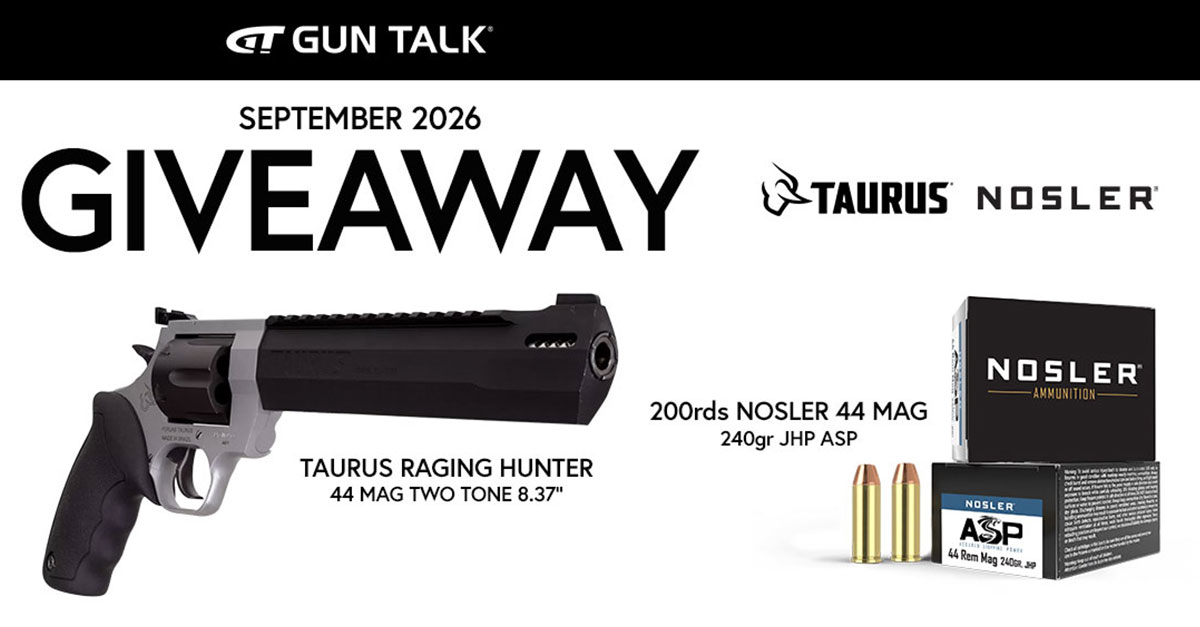
Gun Talk Giveaway
One lucky winner will bring home:
Open to U.S. residents 21+ only. Void where prohibited.