July 14, 2026
Gun Talk Staff
Let’s start with a number, because this one deserves to be read slowly.
That’s not a typo. That’s not a rounding error. That is one hundred and seventy-seven percent more NFA background checks processed in June 2026 than in the same month last year. The raw numbers: 166,677 NFA checks in June 2026 versus 60,147 in June 2025. The suppressor market didn’t just grow this year. It exploded.
And it’s been building since January 1, 2026 — the day the NFA tax stamp dropped to $0 — when the ATF processed approximately 150,000 e-Form submissions in a single day. For context, a normal pre-tax-cut day saw about 2,500. That’s a factor of 60 times in 24 hours. On New Year’s Day. People were doing their NFA paperwork on New Year’s Day because they had been waiting specifically for that day to arrive.
If you’ve been thinking about getting a suppressor, or wondering whether 2026 really is as big a shift as everyone said it would be — here’s your answer. Yes. It really is. And honestly, the timing has never been better to finally pull the trigger on it. Pun intended.
The suppressor story in 2026 is really three stories layered on top of each other, and you can’t fully appreciate the moment without understanding all three — a moment we also broke down from the broader industry angle in our look at the three trends defining the 2026 firearms market.
The $200 NFA tax stamp has been around since 1934. It was designed, in the political context of the New Deal era, to price average Americans out of owning a Tommy gun. It was $200 in 1934, which was roughly equivalent to $4,400 in today’s dollars. The intent was restriction by economics. And it worked — for a long time. Even as the purchasing power of $200 shrank over the decades, the tax remained a meaningful barrier. A $300 rimfire suppressor with a $200 stamp is a $500 purchase. That math stops a lot of first-time buyers.
The One Big Beautiful Bill, signed into law in the summer of 2025 and effective January 1, 2026, eliminated the tax. Not reduced it. Eliminated it. The stamp is now $0. A $300 rimfire suppressor is a $300 purchase. A $580 Banish stainless suppressor is a $580 purchase. The math changed completely, and the market responded with exactly the enthusiasm you’d expect when a 92-year-old barrier gets removed overnight.
The $200 tax wasn’t the only reason people avoided suppressors. The wait time was equally off-putting. At various points in recent years, Form 4 approval times stretched to 18 months or longer. You’d pay for the suppressor, do your paperwork, and then wait a year and a half before you could take it home. For most consumer products, an 18-month wait between purchase and possession would kill the market entirely.
What happened is remarkable. The ATF’s NFA Division, under sustained industry pressure and with the political support of a pro-Second Amendment administration, has dramatically cut processing times. Here’s where approvals stand right now, per the most current data:
| Individual eForm 4 | 3–8 days │ Silencer Central reporting average of 3 days │ Silencer Shop median at 4 days |
|---|---|
| Trust eForm 4 | 19–25 days │ Down from 12–18 months just two years ago |
| Paper Form 4 (indiv.) | 63 days │ Still functional but eForms are dramatically faster |
| Paper Form 4 (trust) | 25 days │ Similar to eForm trust processing |
| Form 1 (make your own) | 62 days eForm │ 33 days paper (unusual reversal — paper faster for Form 1) |
| Wait time context | Peak wait times were 12–18 months as recently as 2022-2023. Individual eForm 4 is now 3 days. That is not a misprint. |
Three days. Not three months. Not three weeks. Three days for an individual eForm 4. If you’ve been putting off the suppressor purchase because you couldn’t stomach a year-and-a-half wait, that reason is gone.
The suppressor market that existed before 2026 was already growing. The suppressor market that exists now is in a different category entirely. At SHOT Show 2026, industry observers noted an “unprecedented” number of suppressor debuts, with Bergara, Canik, Diamondback, Hi-Point, Palmetto State Armory, and Lyman Products all launching their first suppressor models — the same wave of launches we covered in more depth in our 2026 market trends piece. One industry writer observed there was a “full-on race to the bottom to see how cheaply they can be sold” — which sounds like a complaint but is actually a win for buyers. Competition is driving prices down. The quality floor has risen. And the range of options from a $200 rimfire can to a $1,200 precision rifle suppressor has never been broader.
The Banish VRMT 223 SS and HNT 30 SS, which dropped this month at $580 each, are a perfect example. Full stainless construction, 25-30 dB reduction, HUB mount compatibility, in a market where those specs used to command $700-800 before the competition heated up. Budget entry points are real now. The excuse of “I can’t afford a good one” has gotten a lot harder to make.
NSSF has been tracking NFA-specific background checks month by month in 2026, and the trajectory is remarkable:
| January 1, 2026 | ~150,000 eForm submissions in a single day vs. ~2,500 normal daily volume (60x surge) |
|---|---|
| April 2026 | NFA checks up 130% year-over-year |
| May 2026 | 146,551 NFA checks — up 100.4% vs. May 2025 (73,138) |
| June 2026 | 166,677 NFA checks — up 177.1% vs. June 2025 (60,147) |
| Year-to-date | 4.4+ million suppressors already registered in the U.S. and climbing. NSSF projects suppressor ownership to accelerate sharply through 2026. |
| Trend direction | Each month is setting new records. The suppressor market is not showing signs of leveling off. The pent-up demand is still unwinding. |
The context behind those numbers matters. The suppressor market saw 265% growth in Form 4 registrations from 2020 to 2024 — before the tax was eliminated. The total number of suppressors in circulation doubled in that same four-year window. The tax elimination didn’t start this trend. It poured accelerant on a fire that was already burning.
“There’s little doubt that 2026 will be the Year of the Suppressor. Everything is coming together at the right time. The only question is how much growth will we see.” — Paul Erhardt, The Outdoor Wire, January 2026 — and he was right.
Here’s a thing that is genuinely frustrating about the American suppressor conversation: we spent decades treating a firearm safety device like it was something exotic and dangerous, while the rest of the developed world treats suppressors more or less like car mufflers. You can walk into a sporting goods store in the UK, Germany, Finland, or New Zealand and buy a suppressor over the counter, no special paperwork, no federal registration. Because in those countries, requiring a suppressor is considered a courtesy to your neighbors and your own hearing, not a threat to public safety.
In the United States, we slapped a $200 depression-era tax on them and spent 92 years making the process as inconvenient as possible. The result was that millions of American hunters, shooters, and range-goers shot unprotected for decades because the legal path to protecting their hearing was too expensive and too slow to bother with.
The practical case for suppressors is not subtle. Suppressors reduce the noise report of a firearm to safer decibel levels — not Hollywood silence, nothing close to that, but meaningful reduction from around 165 dB for an unsuppressed centerfire rifle to around 130-140 dB suppressed. The threshold for hearing damage is 85 dB with extended exposure and 140 dB instantaneously. A suppressed shot can still be loud enough to cause hearing damage without ear pro, but the margin is dramatically better. And for hunters, a suppressor means you can hear approaching game after you shoot, communicate with your hunting partner without removing hearing protection, and take a follow-up shot without the disorientation of full-noise exposure.
The process in 2026 is simpler than it’s been at any point in the modern era. Here’s the straightforward version:
The decision about individual vs. trust is worth a separate conversation. The short version: an NFA trust lets multiple people — your spouse, adult children — legally possess the suppressor without having to be present every time. It used to involve mandatory fingerprints from every person on the trust. The proposed ATF rule change we covered Thursday would eliminate that requirement, making trust ownership even more attractive. If you’re building a suppressor collection or want family members to have legal access, a trust is usually the smarter long-term move.
For an even deeper breakdown of specific models by use case, our full Suppressor Buyer’s Guide is worth a look. Here’s the quick version:
| Rimfire (.22 LR) | Budget entry point to suppressor ownership. Suppressors for .22 LR are the quietest and most fun — hearing-safe in most configurations. Look at: Silencer Central Banish Backcountry, Dead Air Mask HD, Rugged Oculus. Budget: $150-400. |
|---|---|
| Handgun (9mm / .45 ACP) | Pistol suppressors need a host with a threaded barrel. Most new defensive pistols come threaded now. Look at: Silencer Central Banish 45, Dead Air Ghost, Obsidian 45. Budget: $350-800. |
| Rifle (.223 / 5.56) | Most popular suppressor category. Semi-auto rifle suppressors run hot — stainless or Inconel construction preferred for volume shooting. Look at: Banish VRMT 223 SS ($580), Dead Air Sandman-S, Surefire SOCOM556. Budget: $400-1,000. |
| .30 caliber / bolt rifle | Full-size hunting suppressor. The most practical suppressor for hunters who care about follow-up shots and hearing their guide. Look at: Banish HNT 30 SS ($580), Dead Air Sandman-L, Silencer Central Banish 30 Gold. Budget: $500-1,000. |
| Multi-caliber | One suppressor for everything. Trade-off is that no single suppressor is optimal for every caliber. Look at: SilencerCo Omega 36M, Dead Air Wolfman, Rugged Surge. Budget: $700-1,200. |
| Integral / host-specific | Suppressor built into the firearm. Maximum performance, not transferable to other hosts. Savage AC30 BOB (covered in our 110 Tactical review), Rugged Razor. Premium but purpose-built. |
Let’s be honest with each other for a second. For years, a lot of gun owners had a fully legitimate answer to the question “why don’t you have a suppressor?” The answer was: because adding $200 to the price of the can and then waiting 18 months for a government permission slip was a deal I wasn’t willing to make. That was a reasonable position.
That position is no longer available. The tax is $0. The wait for individuals is about a week. The product selection is better than it has ever been. The ATF is actively working to make the remaining paperwork less painful. And the market — 177% growth in NFA checks, 166,677 in June alone — is telling you in plain numbers that a whole lot of other gun owners figured this out and jumped.
If you hunt, your ears will thank you. If you shoot at the range, your ears and your neighbors’ ears will thank you. If you run a defensive firearm, a suppressor combined with subsonic ammunition fundamentally changes what an indoor defensive scenario means for your hearing. There is no downside to shooting suppressed except the paperwork, and the paperwork just got a lot shorter.
The 92-year headache is mostly over. Welcome to the Year of the Suppressor.



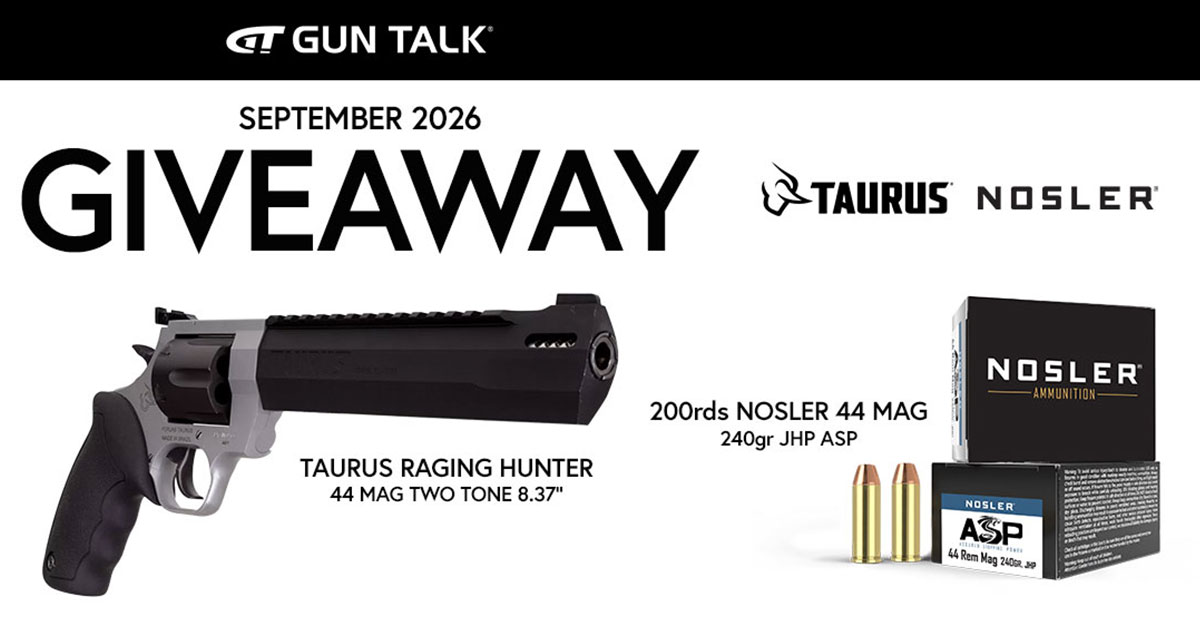
Gun Talk Giveaway
One lucky winner will bring home:
Open to U.S. residents 21+ only. Void where prohibited.